Cycling in Corsica: complete guide to GT20, gravel & cycling routes | Baroudeur
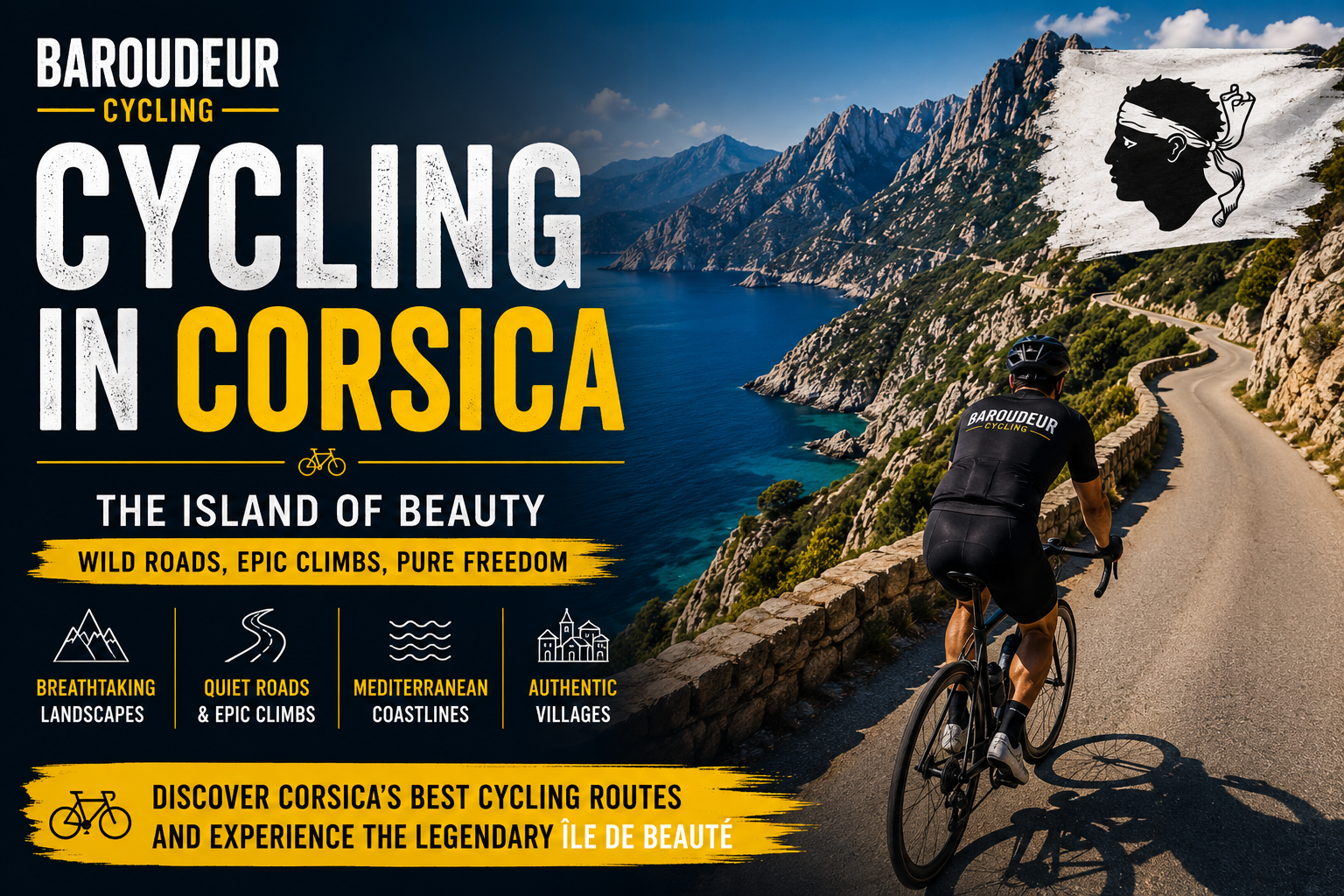
Cycling in Corsica: complete guide to the GT20 and cycling routes of the Île de Beauté
Discover one of the Mediterranean's most spectacular cycling destinations, between wild coastlines, preserved mountains and exceptional perched villages
Corsica undoubtedly represents one of the Mediterranean's most fascinating cycling destinations. Often described as a genuine "mountain rising from the sea," this unique island offers cyclists absolutely striking landscapes where turquoise coastlines meet granite peaks in a rarely equalled visual symphony.
At Baroudeur Cycling, we know how to recognise terrains offering cyclists a truly authentic experience. Corsica proposes exceptional cycling richness: on one hand, the emblematic GT20 route representing a genuine Great Cycling Traversal of the island, and on the other hand, a dense network of small secondary roads and gravel paths winding through preserved landscapes.
This guide offers a comprehensive exploration of Corsica by bike. You'll discover the essentials of Corsican cycling, the mythical GT20 route stage by stage, and the best periods to organise your holiday on this exceptional island.
Why choose Corsica for a cycling holiday?
A unique geography in the Mediterranean
Corsica distinguishes itself through its particularly contrasting geography offering cyclists an impressive variety of experiences. This "mountain rising from the sea" combines granite peaks exceeding 2,000 metres altitude, a jagged coastline of more than 1,000 kilometres, and a preserved interior traversed by the Corsica Regional Natural Park.
This geographical configuration creates striking contrasts: within just a few kilometres, cyclists can pass from turquoise coves to high-altitude forests, from fragrant maquis to villages perched with balcony views over the sea.
Exceptional natural heritage
Corsica shelters several exceptional sites, some classified as UNESCO World Heritage. The Gulfs of Porto, Girolata, the Scandola Reserve and the Calanches of Piana figure among the Mediterranean's most remarkable natural sites.
The Corsica Regional Natural Park, created in 1972, covers more than 40% of the island territory and preserves unique ecosystems. Cycling through these protected spaces offers an enriching experience far beyond simple sporting performance.
A sporting challenge matching the landscapes
The Corsican relief imposes serious physical preparation. Far from being an easy cycling destination, the Île de Beauté proposes demanding ascents, successive mountain passes and substantial cumulative elevation gain that can rival the greatest European mountain destinations.
However, this sporting demand is largely compensated by the beauty of the landscapes traversed and the rare satisfaction of having conquered truly spectacular roads.
To complete your Mediterranean exploration, also discover our France cycling holidays and Portugal destinations.
The GT20: the Great Cycling Traversal of Corsica
An emblematic 600-kilometre route
The GT20 (Grande Traversée 20), also called "A Traversata Maiò" in Corsican, represents the emblematic cycling route of the island. Inaugurated in 2019 at the Col de Vergio, this approximately 600-kilometre route connects Bastia to Bonifacio, crossing the island from north to south.
Like the famous GR20 hiking trail, the GT20 proposes a major sporting challenge with cumulative elevation gain of approximately 9,500 metres and a highest point at the Col de Vergio at 1,477 metres altitude, Corsica's highest paved mountain pass. The route privileges secondary roads and less-frequented departmental roads, thus guaranteeing calm and safety for cyclists.
The route can be completed in 6, 8 or 12 days according to your pace and desires. It can also be ridden in reverse from Bonifacio, offering the advantage of finishing with the longest stage (71 km between Zonza and Bonifacio) descending.
The 12 official GT20 stages
Here are the details of the official GT20 stages, as defined by the framework itinerary:
Stage 1: Bastia → Centuri (58 km)First stage plunging into wild Cap Corse, alternating between secret coves and picturesque villages. Crossing Cap Corse from east to west constitutes the main physical difficulty.
Stage 2: Centuri → Saint-Florent (58 km)Stage following the wild western slope of Cap Corse, with spectacular landscapes and numerous picturesque villages traversed on the D80.
Stage 3: Saint-Florent → Belgodère (61 km)Traversal of the Balagne mountains, a region known for its perched villages and remarkable architectural heritage.
Stage 4: Belgodère → Calenzana (43 km)Shorter stage allowing discovery of the Balagne hinterland and its authentic landscapes.
Stage 5: Calenzana → Galéria (31 km)Short but discovery-rich stage, with arrival at the preserved fishing port of Galéria.
Stage 6: Galéria → Porto (51 km)Traversal of spectacular landscapes close to the Scandola Nature Reserve, classified as UNESCO World Heritage.
Stage 7: Porto → Col de Vergio (34 km)Demanding ascent to the highest point of the route, through the wild interior landscapes.
Stage 8: Col de Vergio → Corte (50 km)Descent and arrival at Corte, Corsica's historic capital and cultural heart of the island.
Stage 9: Corte → Ghisoni (57 km)Traversal of central Corsican mountains, a preserved region offering exceptional panoramas.
Stage 10: Ghisoni → Zicavo (45 km)Stage through the contrasting landscapes of the centre-south of the island.
Stage 11: Zicavo → Zonza (44 km)Arrival at the foot of the Aiguilles de Bavella, with positive elevation gain of approximately 800 metres. The Cuscione plateau, a biodiversity reserve, deserves a detour.
Stage 12: Zonza → Bonifacio (71 km)Ultimate spectacular stage through the extreme southern relief, with descent to Levie, climb to Col de Bacinu offering views over the Gulf of Porto-Vecchio, and triumphant arrival at Bonifacio perched on its cliffs.
To prepare such a cycling challenge in self-supported mode, our bikepacking preparation guide provides essential advice adaptable to long journeys.
The Corsica Cyclo GT20: the annual event
Every year in May, the Corsica Cyclo GT20 gathers ambitious cyclists wishing to take up the challenge of the Great Traversal in sporting mode. This emblematic 598-kilometre event constitutes an essential rendezvous for long-distance and significant elevation enthusiasts.
Corsica's cycling highlights
Cap Corse: the wild northern peninsula
Cap Corse, this approximately 40-kilometre peninsula located in the north of the island, proposes absolutely striking landscapes. The coastal road alternates between historic Genoese towers, preserved coves, authentic hamlets like Erbalunga, and breathtaking views over the Tyrrhenian Sea.
The complete tour of Cap Corse represents approximately 100 kilometres, with substantial elevation (between 690 and 720 metres of positive elevation depending on the route).
Balagne: Corsica's garden
The Balagne, region located in the northwest of the island, offers contrasting landscapes between coast and mountain. Its perched villages like Corbara, Sant'Antonino or Pigna propose cycling stages rich in heritage discoveries.
This region, often called "Corsica's garden," ideally combines sporting challenges (ascents towards perched villages) and authentic cultural discoveries.
Corte: the historic capital
Corte, Corsica's ancient independent capital in the 18th century, represents an essential cycling stop at the heart of the island. Its perched citadel, its historic university and its regional museum offer an exceptional setting for any cultural break.
From Corte, several cycling routes allow exploration of the high valleys of Restonica, Tavignano or Golo, with remarkable mountain landscapes.
Bonifacio: the southern sentinel
Bonifacio, a city perched on its spectacular white limestone cliffs, undoubtedly represents Corsica's most spectacular cycling arrival. Its fortified old town, its cobbled streets and its panorama over the Bonifacio straits make it an architectural and landscape jewel.
For cyclists completing the GT20, arriving at Bonifacio constitutes a visual and emotional reward of rare intensity.
The Scandola Nature Reserve
Classified as UNESCO World Heritage, the Scandola Nature Reserve represents one of the Mediterranean's most preserved sites. Although accessible only by boat from Porto or Galéria, this reserve offers from the surrounding cycling heights exceptional perspectives over its red volcanic rocks and turquoise waters.
Gravel cycling in Corsica: a developing practice
A varied natural terrain
Corsica also proposes remarkable diversity of terrains suited to gravel practice. The forest paths of the Regional Natural Park, the tracks of the mountainous interior and coastal trails offer enthusiasts of this discipline a rich and varied exploration territory.
To deepen your gravel technique before your holiday, consult our resources on gravel riding technique and skill development.
Gravel-friendly zones
Several Corsican regions particularly suit gravel practice: the Cuscione plateaus in Alta Rocca, the forest tracks around Vizzavona, the paths of the Bozio in the centre, or the coastal trails of Cap Corse.
It's important to note that wild camping is prohibited in Corsica, which imposes adapted logistical organisation for bikepacking adventures.
When to plan your cycling holiday in Corsica?
Spring (April-June): the ideal period
Spring undoubtedly constitutes the best period for cycling in Corsica. Temperatures generally oscillate between 15 and 22°C, offering ideal conditions for prolonged effort. Landscapes then don brilliant colours with particularly fragrant maquis blossoms.
Tourist attendance remains moderate before the arrival of high summer season, allowing cycling on quiet roads. This is also the period chosen for the Corsica Cyclo GT20 in May.
Summer (July-August): to avoid for cycling
Corsican summer can prove difficult for cycling practice. Temperatures regularly reach 30-35°C along the coast and sometimes more in the interior, whilst significant tourist attendance makes traffic denser on main routes.
Only very experienced cyclists, with dawn departures and mandatory pauses during hot hours, can consider this period. The heights nevertheless offer more bearable conditions for determined cyclists.
To effectively manage efforts in hot climates, consult our long-distance cycling nutrition guide.
Autumn (September-October): an excellent alternative
Autumn offers particularly favourable conditions for cycling in Corsica. Temperatures become pleasant again (18-25°C), tourist attendance decreases significantly, and landscapes retain their vegetal richness.
This is also the Corsican harvest period, adding a remarkable gastronomic dimension to the holiday, notably on the eastern coast and in Balagne.
Winter (November-March): reserved for the most motivated
Corsican winter remains mild along the coast (10-15°C) but quickly becomes difficult at altitude, with regular snowfall above 1,000 metres. This period therefore remains reserved for highly motivated cyclists, mainly on coastal zones.
Mountain roads, notably the Col de Vergio, can be closed in winter, making complete GT20 traversal impossible during this season.
How to prepare your cycling holiday in Corsica?
Equipment adapted to island specificities
The Corsican relief imposes carefully selected equipment. A bike equipped with appropriate gearing (compact or sub-compact with wide cassette) proves indispensable for facing long ascents and sometimes demanding gradients.
Potential heat also imposes systematic hydration and impeccable sun protection. Wind, particularly on Cap Corse and exposed zones, deserves anticipation with adapted technical clothing.
To choose the ideal bike, our touring bike selection guide provides valuable advice.
Serious physical preparation
The GT20 and Corsica's main cycling routes require genuine physical preparation. The capacity to string together stages of 50-70 kilometres with 1,000 to 1,500 metres of daily positive elevation constitutes a prerequisite for fully enjoying the experience.
Our cycling training camp preparation guide provides valuable advice for effectively preparing this type of mountain holiday.
Logistics: access and transport
Access to Corsica takes place mainly by ferry from Marseille, Nice or Toulon, as well as by plane from major French and European airports. Maritime companies generally accept bikes free or with a modest supplement.
For internal transport, the historic Bastia-Ajaccio and Ajaccio-Calvi rail connections also allow interesting combinations for cyclists not wishing to complete a loop itinerary.
Corsica with Baroudeur Cycling
Our current Mediterranean destinations
Although Corsica doesn't yet form part of our official destination portfolio, at Baroudeur Cycling, we accompany passionate cyclists in discovering Europe's most beautiful cycling territories.
Our current French and Mediterranean destinations :
France cycling holidays : Discover our hexagonal programmes, notably in the Esterel massif which also offers contrasting Mediterranean landscapes.
Portugal cycling holidays : Perfect Mediterranean complementarity with the Algarve, the National 2 route and Atlantic coasts.
Gravel cycling holidays : Diversified gravel programmes across Europe's best terrains.
Custom trips to explore Corsica
Our custom cycling trips service allows imagining personalised cycling experiences, including towards destinations like Corsica. If you dream of taking up the GT20 challenge or exploring the wild coasts of the Île de Beauté, don't hesitate to contact us to discuss accompaniment possibilities.
Personalised coaching to prepare the GT20
For those wishing to tackle the demanding GT20 challenge in the best conditions, our cycling coaching programme offers physical preparation specifically adapted to the requirements of Corsica's Great Traversal.
Conclusion: Corsica, an exceptional cycling adventure
Corsica undoubtedly represents one of the Mediterranean's most spectacular and demanding cycling destinations. The unique combination of its mythical GT20, preserved coasts, majestic mountains and exceptional cultural heritage creates an absolutely extraordinary playground for all ambitious cyclists.
Whether you're attracted by the complete GT20 challenge, by discovering Balagne and its perched villages, or by exploring wild Cap Corse, the Île de Beauté will fulfil all your cycling aspirations.
The gastronomic richness of the territory, with its Corsican charcuteries, farm cheeses, AOC wines and island specialities, adds a supplementary dimension to the experience. Each stage becomes an opportunity for authentic culinary discoveries in a region where the table remains sacred.
Ready to live your next cycling adventure in Corsica with Baroudeur Cycling? Don't hesitate to contact us to build together your next cycling project on this exceptional island.