Giant Propel 2026: complete review of the aero bike turned climber | Baroudeur
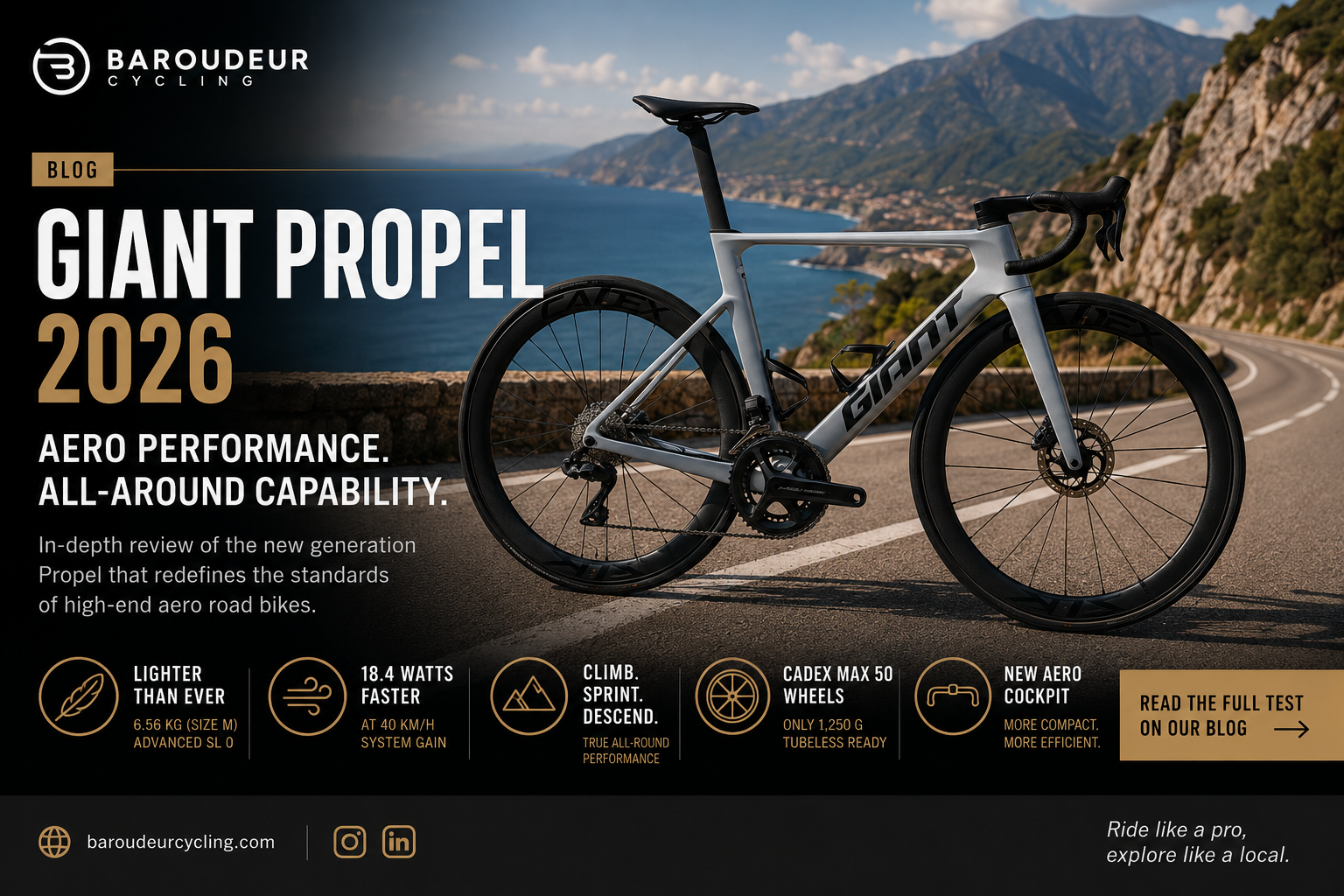
Giant Propel 2026: complete review of the new aero bike turned versatile
Discover our detailed analysis of the new Propel generation that redefines high-end aero bike standards, between remarkable lightness, precise handling and rediscovered versatility
The Giant Propel 2026 marks a major turning point in the history of aerodynamic bicycles. With this new generation, Giant no longer seeks only to produce the pure sprinter's bike that built the Propel's reputation. The bike now positions itself as a complete racing machine, capable of excelling on the flat as well as on climbs and descents, questioning traditional boundaries between aero bikes and climbing bikes.
At Baroudeur Cycling, we pay particular attention to selecting equipment adapted to each cycling practice. The Propel 2026 deserves an in-depth analysis because it embodies a fundamental evolution of the aero bike concept, with significant technical gains and product positioning that redefines high-end market expectations.
This complete review offers a detailed analysis of the Giant Propel 2026, its technical characteristics, its terrain behaviour and its positioning within the current high-end racing bike landscape.
Giant Propel 2026: a complete new generation
Three levels for a complete platform
The Propel 2026 constitutes a genuine new generation, declined in three clearly differentiated levels:
Propel Advanced SL: the lightest and most high-end version, destined for WorldTour competition and cyclists demanding the ultimate technical level. This version is notably used by Team Jayco AlUla in the professional peloton.
Propel Advanced Pro: the performance/price compromise, retaining most technical evolutions whilst offering more reasonable price accessibility.
Propel Advanced: access to the aero platform with a more contained budget, allowing benefit from the Propel's aesthetics and position without targeting a WorldTour configuration.
A rethought philosophy
Unlike previous generations more specifically oriented towards sprinting and flat riding, the new Propel 2026 aspires to become a genuinely complete racing bike. This evolution responds to a market trend: cyclists now seek a unique bike capable of doing everything, rather than ultra-specialised machines.
This versatile approach fits perfectly with a varied cycling practice, like the one we privilege at Baroudeur. To deepen your understanding of bike choice according to your practices, consult our touring bike selection guide.
What really changes on the Propel 2026
A system evolution rather than a revolution
The Propel 2026 retains a silhouette close to the previous generation, but Giant has worked on the entire system: frame, fork, cockpit, wheels, tyres and rider position. This global approach explains why announced gains far exceed what the frame alone could offer.
The main technical evolutions are as follows:
- Lightened Advanced SL frame
- New narrower integrated cockpit
- New CADEX Max 50 wheels
- New CADEX Aero tyres
- Increased stiffness
- Better vertical filtration
- Tyre clearance up to 32 mm
- Lower seatstays
- New fork
- Complete cable integration
Giant announces up to 355 g savings on the complete Advanced SL 0 bike compared to the previous generation, whilst the Advanced SL frame alone would be approximately 45 g lighter.
Weight: an aero bike under the UCI limit
The Propel Advanced SL 0 is announced at approximately 6.56 kg in size M in its high-end configuration. This remarkable figure positions the bike under the UCI limit of 6.8 kg before the eventual addition of certain accessories.
It's worth qualifying this data however. Cyclist magazine weighed a size L model equipped with pedals at approximately 6.7 kg. The French test by 3bikes recorded approximately 6.84 kg with Garmin pedals, bottle cages and computer mount. The most accurate formulation therefore remains: "in its high-end Advanced SL 0 configuration and size M, Giant announces a weight of approximately 6.56 kg."
This characteristic revolutionises the possible use of the bike, historically penalised on long ascents by its superior weight compared to pure climbing bikes.
Aerodynamics: understanding the announced 18.4 watts
A global gain to contextualise
Giant claims a global advantage of 18.4 watts at 40 km/h compared to the previous Propel. This impressive figure does not come solely from the frame however. It includes:
- The new narrower cockpit
- The more compact rider position
- The wheels
- The tyres
- Reduced rolling resistance
- Frame and fork evolutions
CyclingNews magazine highlights that a significant portion of the gain comes from the new cockpit and tyres, rather than a radical frame transformation. This precision is important to integrate for objectively evaluating the platform's real progress.
A system approach rather than component
This way of announcing gains testifies to an industry evolution towards a complete system approach. It's no longer only about optimising a tube or a fork, but the entire cyclist-bike interaction in the airflow.
This philosophy explains why evolutions remain visually limited at the frame level: the essential work has concentrated on components and on the system's global interaction with the cyclist.
The new aero cockpit: major evolution
The new cockpit constitutes one of the most important evolutions of the Propel 2026. Its main characteristics are:
- Narrower at the hoods level
- Flared in the drops to maintain control and comfort during sprints
- Lighter
- Completely integrated
- Designed to reduce the rider's frontal surface
This evolution probably improves the rider's position as much as the aerodynamics of the component itself. The narrower cockpit naturally forces a tighter hand position, significantly reducing the cyclist's frontal area in the wind.
The CADEX Max 50 wheels: lightness and performance
The highest-end models use the new CADEX Max 50 wheels, which constitute a key element of the new Propel's versatile positioning.
Their main characteristics include a 50 mm profile balancing aerodynamics and behaviour in crosswinds, carbon spokes offering lightness and stiffness, an announced weight close to 1,250 g strongly contributing to the bike's climbing and reactive character, a new spoke/hub interface, along with now standard tubeless compatibility.
This weight level for 50 mm depth wheels remains remarkable and largely explains why the Propel 2026 suddenly becomes credible on long ascents, historically a weakness of aero bikes.
Propel Advanced SL, Advanced Pro or Advanced?
The Propel Advanced SL: WorldTour competition
The SL version's positioning is clear: it's the competition and WorldTour version of the platform. It combines Advanced SL carbon, integrated seatpost, monoblock cockpit, maximum stiffness, minimum weight, high-end CADEX wheels depending on models, Dura-Ace or SRAM Red groupsets.
Advantages: very light, very stiff, premium equipment, competition behaviour, refined aesthetics.
Constraints: high price, seatpost to cut, more complex resale and adjustments, proprietary components.
The Propel Advanced Pro: the best compromise
The Pro's positioning corresponds to the best compromise between performance, ease of use and price. It retains most evolutions: general aerodynamics, geometry close to the SL, cable integration, performant cockpit, carbon wheels, adjustable and replaceable seatpost.
This version loses approximately 300 g at equivalent components compared to the Advanced SL, according to data presented by 3bikes. This compromise remains reasonable for most amateur cyclists, even demanding ones.
The Propel Advanced: access to the aero platform
The Advanced version's positioning corresponds to access to the Propel platform with a more contained budget. It uses less light carbon construction and more accessible equipment, whilst retaining the Propel's aesthetics and general behaviour.
This level remains relevant for a cyclist wishing the Propel's aesthetics and position without targeting a WorldTour configuration, notably for practitioners privileging daily training over pure competition.
Terrain behaviour: professional test feedback
On the flat: speed and acceleration
The Propel remains very fast on flat terrain, but the new generation seems to offer less the sensation of a heavy bike launched on its inertia. Light wheels and overall weight reduction rather favour accelerations, rhythm changes, attacks, corner exits and sprints.
The 3bikes test describes a bike more willing to accelerate often than to only maintain speed with a strong inertia sensation. This evolution corresponds to more dynamic cycling practice, with varied rides rather than long constant-speed traversals.
Climbing: the most impressive evolution
This is probably the most impressive evolution of the Propel 2026. With a weight close to that of a climbing bike, the Propel can now be used on long ascents, hilly routes, cyclosportives, mountain stages and very mixed races.
Cyclist and 3bikes tests both highlight the bike's great ease as soon as the road rises. The French 3bikes test notably mentions the Col de Vence climb, where the Propel 2026 proved particularly comfortable despite its aero label.
To prepare this type of demanding ascents, consult our cycling training camp preparation guide.
On descents: precision and confidence
Feedback highlights several remarkable qualities on descents: a precise front end, excellent stiffness, stable behaviour, predictable steering and good confidence at high speed.
This combination is particularly appreciable on technical mountain descents, where the bike's behaviour plays a determining role in safety and enjoyment.
On degraded roads: surprising comfort
The new generation claims improved vertical filtration, notably thanks to lowered seatstays and evolution of the rear frame zone.
Tyre clearance up to 32 mm also significantly increases comfort without profoundly transforming the bike's behaviour. This characteristic considerably broadens the Propel's usage spectrum, now usable even on hilly roads of irregular quality.
Converging professional tests
Cyclist: a successful transformation
Cyclist magazine conducted one of the most complete tests of the Propel Advanced SL 2026. The journalist notes very great lightness, strong stiffness, precise behaviour, excellent climbing capacity, good descent stability, satisfying comfort for a racing bike and an immediate sensation of speed.
Reservations mainly concern the integrated seatpost, the proprietary fork steerer, reduced adaptability at the front and relatively modest visual frame evolutions.
3bikes: the French reference analysis
The French 3bikes test probably constitutes the best source for evaluating the Propel 2026 in a European practice context. The analysis covers stiffness gains, real weight, the Col de Vence climb, accelerations, CADEX Max 50 wheels, flat behaviour, descent precision, cockpit, tyres and sensations compared to a pure aero bike.
The tester finds the bike particularly impressive on climbs and in accelerations. He is more reserved about the inertia sensation at high speed and about the original tyres.
BIKE Magazin and TOUR Magazin: top marks
Reference German media BIKE Magazin and TOUR Magazin both award a remarkable score of 1.4 to the Propel Advanced SL 2026 (the German rating scale being inverted compared to the French 5-point system). BIKE Magazin details: 1.5 for laboratory measurements, 1.2 for equipment.
The Propel is presented by these media as an aero bike that has become genuinely versatile, more through its lightness and balance than through spectacular pure speed gains.
Strengths of the Giant Propel 2026
Based on converging professional tests, several strong points clearly emerge:
- Exceptional weight for an aero bike
- Very good climbing capabilities
- Aerodynamics worked as a complete system
- Strong stiffness during accelerations
- Very light CADEX wheels
- Genuine road versatility
- Precise descent behaviour
- Advanced Pro versions easier to adjust than SL
- Pricing sometimes lower than certain direct competitors
- Surprising comfort thanks to frame evolutions and possibility of using 32 mm tyres
Limitations to consider
Limited visual evolution
The frame strongly resembles the previous generation. A significant portion of gains comes from the cockpit, wheels and tyres, which may disappoint cyclists expecting a major aesthetic rupture.
The integrated seatpost
On Advanced SL versions, the integrated seatpost must be cut to the correct height. This characteristic complicates remote purchase, major position changes, resale, bike lending and certain transports.
A proprietary cockpit
Integration improves aesthetics and aerodynamics, but reduces quick adjustment possibilities and potentially increases replacement costs in case of breakage.
A high price
The high-end version significantly exceeds €10,000, even though Advanced Pro versions allow access to the new platform at a more rational price. This positioning nevertheless remains reserved for a wealthy or passionate clientele.
Aerodynamic gains to contextualise
The announced 18.4 watts include rolling resistance and the rider's narrower position. It's not solely a pure aerodynamic gain from the frame, which deserves clarification for objectively evaluating progress.
Propel or TCR: which choice in 2026?
This question naturally emerges with the new Propel 2026. Historically, the Giant range articulated clearly: the TCR for climbers, the Propel for sprinters and rouleurs. With a now light and versatile Propel, the boundary becomes blurred.
Cycling Weekly magazine openly asks the question: can the Propel replace the TCR as the unique competition bike? The answer mainly depends on the cyclist's profile and preferences.
Choose the Propel 2026 if you seek a versatile aero bike, appreciate modern integrated aesthetics, regularly ride on flat and hilly terrain, and have the corresponding budget.
Choose the TCR if you privilege mechanical simplicity, prefer more traditional geometry, mainly ride in pure mountain terrain, and want a bike easy to adjust and resell.
Who is the Giant Propel 2026 for?
The ideal cyclist profile
The Propel 2026 mainly addresses three types of demanding cyclists:
The amateur competitor seeking a unique bike capable of doing everything in racing, from mass sprints to mountain stages, including hilly cyclosportives. The Propel's rediscovered versatility now avoids the need for several specialised bikes.
The passionate practitioner appreciating high-end bikes, modern refined aesthetics and optimal performance. The Propel 2026 offers a genuinely premium riding experience on all types of routes.
The versatile cyclist whose rides regularly combine flat, hilly and mountain terrain. The Propel's rediscovered lightness finally allows serenely considering long ascents without excessive compromise.
Less suitable uses
The Propel 2026 proves less relevant for:
- Cyclists seeking a versatile gravel bike (then prefer a Revolt Advanced Pro)
- Bikepacking practitioners or comfortable long rides (prefer an endurance bike)
- Cyclists seeking mechanical simplicity and ease of maintenance
- Contained budgets for which other more rational solutions exist
The Propel 2026 for your Baroudeur Cycling holidays
An ideal bike for our road routes
The Propel 2026 proves particularly suited to terrains encountered during our cycling holidays. Algarve roads, mainland Portugal passes and hilly French routes constitute an ideal playground for this type of versatile aero bike.
Discover our Algarve road cycling holiday to explore the possibilities offered by this type of bike in an exceptional Mediterranean environment.
For cyclists preferring a more complete road experience, our complete traversal of the National 2 route in Portugal represents a remarkable challenge adapted to the Propel 2026's capabilities.
Personalised coaching for preparation
Owning a performant bike like the Propel 2026 requires physical preparation matching its capabilities to fully exploit them. Our cycling coaching programme offers physical preparation specifically adapted to your cycling objectives, whether cyclosportives, events or simple personal ambitions.
Optimising your road practice
Our long-distance cycling nutrition guide provides valuable advice for getting the best from your rides, notably during long cyclosportives where nutritional strategy makes all the difference.
Conclusion: the Propel 2026, an aero bike turned climber
The Giant Propel 2026 establishes itself as one of the current references in high-end aero bikes, whilst redefining traditional boundaries of the category. Numerous converging professional tests (Cyclist, 3bikes, BIKE Magazin 1.4, TOUR Magazin 1.4, L'Expert Vélo 4.8/5) confirm its remarkable qualities: exceptional lightness, rediscovered versatility, precise behaviour and high efficiency.
This bike constitutes a particularly judicious choice for cyclists seeking a unique racing bike capable of doing everything, from flat sprinting to long mountain pass ascents, including technical descents. The combination of exceptional weight for an aero bike and advanced aerodynamic work on the entire system offers a genuinely premium riding experience.
Limitations nevertheless exist: modest visual frame evolution, integrated seatpost constraints on SL versions, proprietary cockpit limiting quick adjustments and high price on high-end configurations. These points must be evaluated according to your priorities and real cycling practice.
For most demanding cyclists seeking a versatile aero bike capable of rivalling the best climbing bikes, the Propel 2026 remains a difficult choice to surpass in its category. The transformation undertaken by Giant succeeds brilliantly: the pure sprinter's bike becomes a complete racing machine.
Ready to live your next cycling adventure with the bike adapted to your objectives? Don't hesitate to contact us at Baroudeur Cycling to build together your next cycling project, whether a Portugal holiday, a French adventure or personalised accompaniment for choosing your equipment.