Mips helmet system: complete guide, how it works and real benefits | Baroudeur
Mips helmet system: complete guide, how it works and real benefits
Discover everything you need to know about the Mips technology now equipping most premium cycling helmets and its real impact on crash protection
Published on Tuesday, April 8, 2026
The Mips system represents today one of the most widespread safety technologies on the cycling helmet market. Present on the vast majority of high-end models, this Swedish system has profoundly modified the approach to cyclist protection in recent years. However, despite its massive presence in both amateur and professional pelotons, its actual functioning and concrete benefit often remain poorly understood.
At Baroudeur Cycling, we pay particular attention to cycling safety issues. The helmet constitutes one of the most determining elements of a cyclist's kit, and understanding the technologies it incorporates allows for informed choices adapted to your real practice.
This complete guide offers an in-depth analysis of the Mips system: its origin, its precise functioning, the various available variants, its real benefit according to independent tests, as well as the competing alternatives that now exist on the market.
What is the Mips system?
Origin and philosophy
The Mips system, acronym for "Multi-directional Impact Protection System", finds its origin in research work conducted in Sweden in the 1990s on brain biomechanics during impacts. This system is developed and marketed by the Swedish company Mips AB, which licenses its technology to numerous helmet manufacturers worldwide.
The fundamental philosophy of Mips rests on an important scientific observation: during a cycling crash, impacts rarely occur perfectly perpendicular to the helmet surface. Most shocks present an oblique component, which generates particularly damaging rotational forces for the brain.
The technical principle
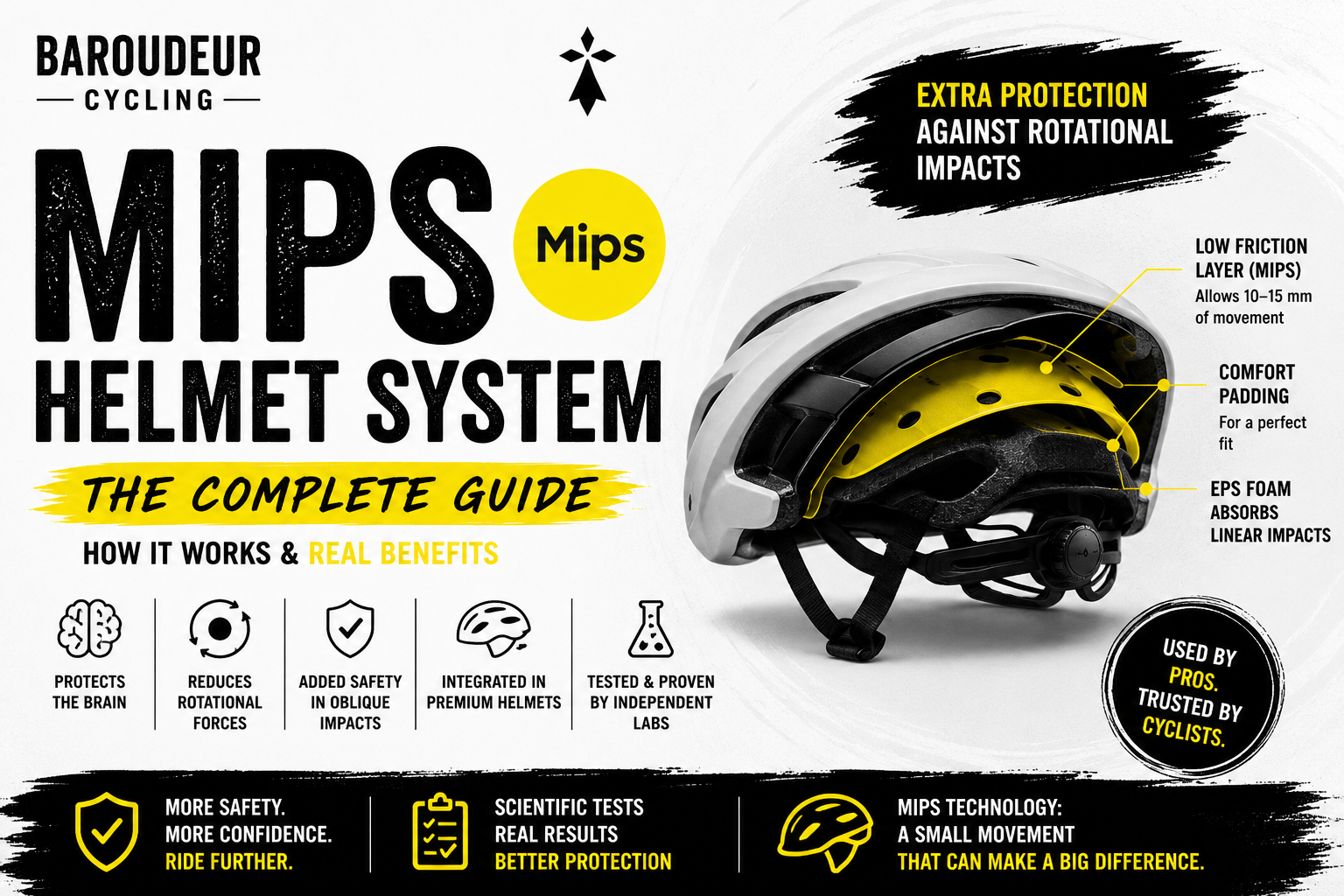
Concretely, the Mips system adds a thin low-friction layer inside the helmet, generally between the absorbent EPS foam and the padding in contact with the head. This layer allows relative movement between the cyclist's head and the helmet itself during certain oblique impacts.
According to official Mips explanations, this movement can reach 10 to 15 millimetres during the first milliseconds of an impact. This slight mobility aims to absorb and redirect part of the rotational forces that would otherwise be transmitted directly to the brain.
Why are rotational forces so important?
The science of oblique impacts
Neuroscience research has progressively demonstrated that severe brain injuries often result less from pure linear impact than from rotational movements imposed on the brain. These movements can cause stretching and rupturing of nerve fibres (axons), notably in the most vulnerable brain areas.
Traditional helmets were historically designed to absorb mainly linear impacts, using EPS foam to slow head deceleration. The Mips system introduces a complementary layer specifically intended to manage the rotational component of the impact.
A major evolution in helmet design
This complementary approach marked a significant evolution in the cycling helmet industry. Since its introduction, most premium manufacturers have adopted the Mips system or developed their own competing solutions, testifying to a general awareness of the importance of managing rotational forces.
To choose a helmet adapted to your practice, consult our analysis of the Giant Rev Pro Mips 2026 helmet which integrates the latest generation Mips Air Node Pro system.
The different Mips families
Mips Essential Core
The Mips Essential Core constitutes the historic and most widespread system. It consists of a characteristic yellow low-friction layer placed inside the helmet. This entry-level version equips numerous mid-range helmets and remains effective, even though it presents some drawbacks: it can slightly penalise ventilation and add a few grams to the helmet weight.
Despite these limitations, the Essential Core has demonstrated its effectiveness in numerous independent tests and remains a solid foundation for rotational protection.
Mips AirNode and Air Node Pro
The Mips AirNode and Air Node Pro systems represent the modern evolution of the concept. They are directly integrated into the helmet padding rather than adding a complete supplementary layer. This approach presents several major advantages:
- Reduced weight compared to Essential Core
- Better aesthetic integration
- Reduced impact on ventilation
- Improved comfort in contact with the head
- Preserved rotational protection functionality
The Mips Air Node Pro, notably used on the new Giant Rev Pro Mips 2026 helmet, perfectly illustrates this technical evolution.
Mips Evolve
The Mips Evolve represents another technical approach, with a system specifically designed to offer even more discreet integration and minimal impact on other helmet characteristics. This variant equips certain recent high-end models.
Other specialised variants
Mips also proposes specific versions adapted to different uses: Mips Spherical (notably used by Giro), Mips Integra for certain mountain bike helmets, and other variants in constant development. Each version seeks to optimise a particular compromise between protection, weight, ventilation and cost.
How to interpret Virginia Tech tests?
An independent global reference
The Virginia Tech laboratory, in collaboration with the Insurance Institute for Highway Safety, represents today the independent global reference for cycling helmet safety evaluation. Its rigorous protocol tests hundreds of models and awards ratings from 1 to 5 stars.
The Virginia Tech protocol notably evaluates helmets' capacity to reduce linear acceleration, rotational acceleration and certain risks associated with oblique impacts in conditions reproducing real accidents.
Mips helmets in the rankings
Helmets equipped with the Mips system regularly appear in the best scores of the Virginia Tech ranking. However, this correlation should not be interpreted simplistically. Several factors come into play:
The helmet's overall quality constitutes the primary criterion: a poorly designed Mips helmet can obtain worse results than an excellent non-Mips helmet, because the overall structure, EPS and geometry play a determining role.
System integration also counts: the way the manufacturer integrates Mips into their helmet directly influences its real effectiveness.
Competing technologies can achieve comparable results: systems like Trek's WaveCel or Kask's WG11 also obtain excellent results in independent tests.
The real benefits of the Mips system
Demonstrated rotational protection
Numerous biomechanical studies and independent tests have demonstrated that helmets equipped with the Mips system can effectively reduce rotational forces transmitted to the brain during certain oblique impacts. This reduction, although difficult to quantify precisely in real life, represents a measurable improvement in laboratory conditions.
Massive market adoption
The adoption of the Mips system by nearly all premium cycling helmet brands constitutes an indirect indicator of its perceived interest by the industry. Giro, Specialized, Bell, Giant, POC, MET, Trek and many other manufacturers integrate Mips in their flagship models. This broad adoption has also progressively democratised the technology across more accessible price ranges.
Constant evolution
The Mips system continues to evolve with versions increasingly lighter, better integrated and less penalising in terms of ventilation. This constant evolution testifies to a continuous improvement approach benefiting cyclists.
Important limitations and nuances
Mips is not a miracle solution
It is essential to understand that the Mips system does not constitute an absolute protection guarantee. No helmet, even equipped with the best current technologies, can prevent all injuries in all accident scenarios. Physics imposes fundamental limits to possible protection.
One criterion among others
Mips constitutes one criterion among many others to consider when choosing a helmet. Correct size, precise fit, stable retention, EPS shell quality and horizontal helmet position on the head remain determining factors for effective safety.
To effectively prepare your long rides where equipment plays a crucial role, consult our expert cycling resources on long-distance ride management.
Variable impacts according to accidents
Studies show that the Mips benefit varies considerably according to the type of impact suffered. On a perfectly linear impact, the Mips system brings little additional advantage compared to a well-designed traditional helmet. It's primarily on oblique impacts that its benefits manifest most clearly.
A slight extra cost
Helmets equipped with the Mips system generally cost 20 to 50 euros more than their non-Mips equivalents. This extra cost remains reasonable for the additional protection provided, but can weigh in purchasing decisions on more affordable ranges.
Competing alternatives to Mips
Trek/Bontrager's WaveCel system
Trek and its Bontrager brand have developed their own technology called WaveCel. This system uses a polymer honeycomb structure that replaces or complements the traditional EPS layer. According to Trek, this structure allows simultaneous management of linear and rotational forces.
WaveCel presents interesting results in certain independent tests and represents an interesting technical alternative to traditional Mips.
Kask's WG11 protocol
The Italian brand Kask has chosen not to use the Mips system and has developed its own internal test protocol called WG11 (Rotational Impact Assessment). Kask claims that its helmets offer equivalent or superior rotational protection through their overall design.
This approach has sparked debates in the industry, but Kask helmets generally obtain good results in independent Virginia Tech tests, which partially validates this alternative philosophy.
POC technologies
POC uses several proprietary technologies, notably SPIN (Shearing Pad INside) on certain models, as well as Mips on others. This mixed approach testifies to in-depth reflection on the various available technical solutions.
The RLS system
A more recent competing system called RLS (Rotational Layer System) is beginning to appear on certain helmets. Initial independent tests show promising results, comparable or even superior to certain Mips implementations.
Diversity as strength
This diversity of competing technologies globally constitutes good news for cyclists. It stimulates innovation, pushes each solution to improve and allows each cyclist to find the compromise that best corresponds to their practice and budget.
How to properly choose your Mips helmet?
Size remains the priority criterion
No protection technology can compensate for a poorly fitted helmet. The absolute priority when choosing remains the correct size. A helmet too large will move during an impact and lose part of its protective effectiveness.
To correctly choose your size, measure your head circumference approximately two centimetres above the eyebrows, above the ears and around the widest part of the back of the skull.
Verify real comfort
A helmet must be worn for several hours during long rides. Comfort felt during fitting constitutes an essential criterion. Verify notably that the helmet doesn't create painful pressure points, that it remains stable during dynamic movements and that it doesn't tilt backwards.
Consider ventilation according to your practice
Ventilation needs vary considerably according to practices. A cyclist mainly practising endurance rides in hot regions will privilege a highly ventilated helmet, whilst a competitor seeking pure aerodynamics may accept a different compromise.
To prepare your rides in hot climates, consult our long-distance cycling nutrition guide.
Consult independent tests
Virginia Tech rankings constitute an excellent basis for objective comparison between different models. They allow identifying helmets offering the best protection levels, regardless of the system used (Mips or alternative).
Adapt to your budget
Helmets equipped with the Mips system exist in a wide price range, from entry-level models around 80 euros to premium helmets exceeding 300 euros. The real protection difference between an excellent 150-euro helmet and a 300-euro premium model can be marginal, the essential being to have a well-designed rotational protection system.
Best practices for helmet use
Correct fitting
Once the helmet is chosen, its correct fitting determines the real effectiveness of protection. The helmet must position horizontally on the head, with the front edge approximately two fingers above the eyebrows. Straps must form a Y under the ears, and the chin strap must allow passage of only one finger.
Systematic replacement after impact
An absolute rule applies: any helmet having suffered a significant impact must be replaced, even if it doesn't present visible damage. EPS foam crushes irreversibly during a shock and loses its protective effectiveness, even if the outer shell remains intact.
Recommended lifespan
Most manufacturers recommend replacing your helmet every 3 to 5 years, even in the absence of impact. Constituent materials naturally age under the effects of UV rays, heat and humidity, which can affect their long-term protective effectiveness.
Regular maintenance
Regular maintenance extends your helmet's lifespan and maintains its effectiveness. Regularly clean the padding with mild soap, periodically verify the condition of straps and buckle, and store your helmet in a temperate location sheltered from shocks and direct light.
To deepen your cycling practice and optimise your equipment, consult our touring bike selection guide.
Mips helmets and Baroudeur cycling practices
For Portugal and France holidays
Helmets equipped with the Mips system prove particularly adapted to conditions encountered during our cycling holidays. Long rides in the Algarve, hilly ascents in France and long routes like the National 2 in Portugal fully benefit from a premium helmet that is both well-ventilated and safe.
Discover our Algarve road cycling holiday or our National 2 traversal in Portugal to explore our possibilities.
For an overview of our programmes, discover our Portugal cycling holidays and our France cycling holidays.
For gravel practices
Mips helmets also equip numerous models adapted to gravel practice. This practice sometimes involves technical crashes on varied surfaces, and rotational protection constitutes a particularly precious asset.
Discover our gravel cycling holidays for demanding gravel adventures.
Bike rental in Portugal
If you wish to discover our cycling holidays in Portugal without transporting your equipment, our bike rental service offers quality bikes adapted to all practices.
Personalised coaching
For those wishing to structure their cycling preparation and optimise their performance, our cycling coaching programme offers personalised support adapted to your objectives.
Conclusion: Mips, a major evolution in cycling safety
The Mips system unquestionably represents one of the major evolutions in cycling safety over the past twenty years. Its principle of protection against rotational forces responds to a real need identified by neuroscience research, and its massive adoption by the industry testifies to its perceived relevance.
However, Mips should not be considered a miracle solution. A cyclist's effective safety depends on numerous factors: the helmet's overall quality, its precise fit, road behaviour adopted, as well as the presence of other safety equipment such as lights, visible clothing and good knowledge of the road code.
Competing alternatives like WaveCel, WG11 or SPIN demonstrate that other technical approaches can achieve comparable results. This diversity globally constitutes good news for cyclists, stimulating innovation and allowing everyone to find the technical compromise corresponding to their practice.
For most demanding cyclists, opting for a helmet equipped with the Mips system (or an equivalent competing technology having obtained good results in independent tests) constitutes today a judicious choice. Combined with correct fitting and appropriate use, this technology significantly contributes to improving protection in case of accident.
Ready to live your next cycling adventure in the best safety conditions? Don't hesitate to contact us at Baroudeur Cycling to build together your next cycling project, whether a Portugal holiday, a French adventure or personalised accompaniment for choosing your equipment.